
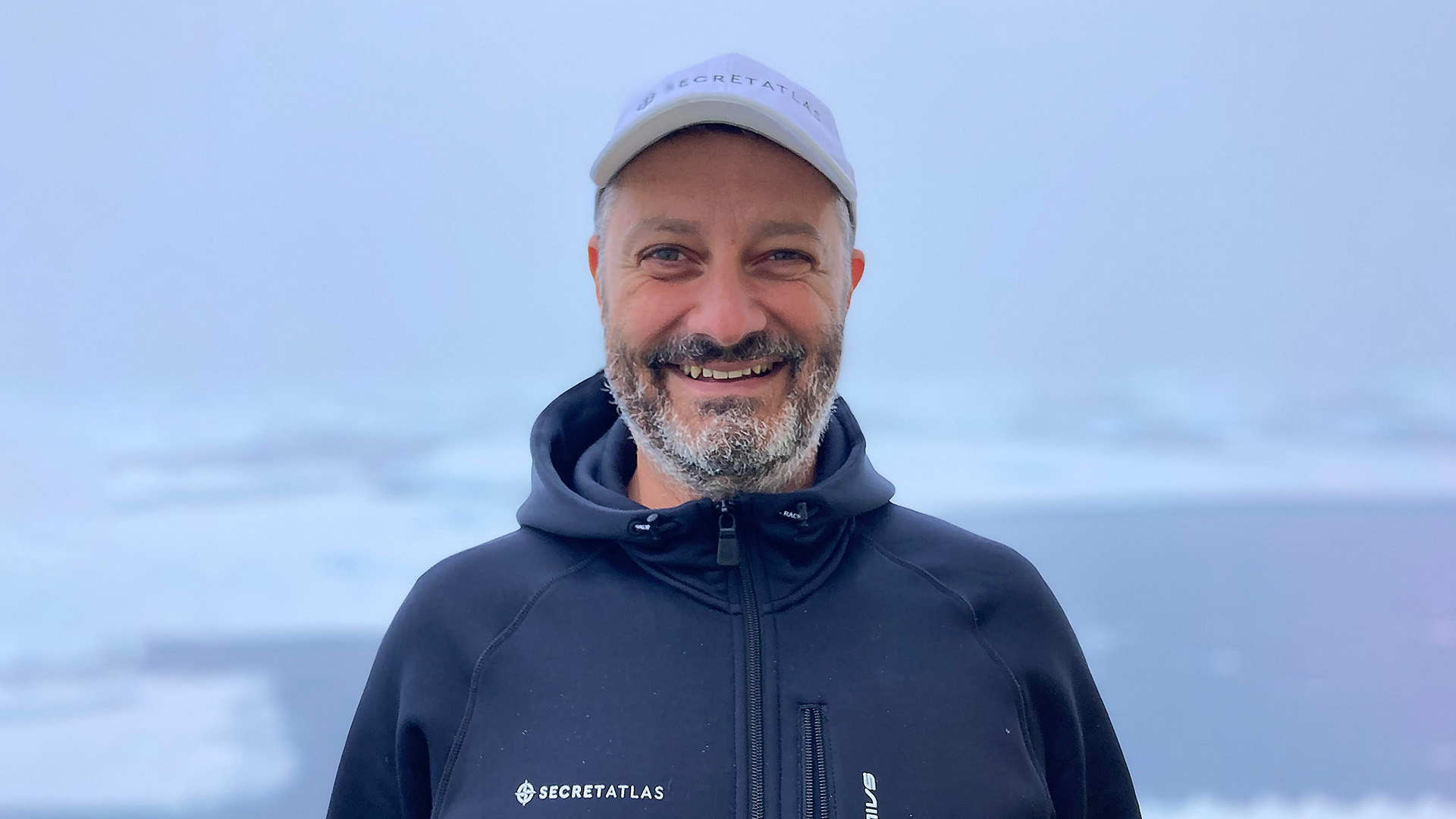
Michele D’Agostino, co-founder of Secret Atlas expedition micro cruises / © Secret Atlas Media
For Michele D’Agostino, the polar regions are not places to be consumed or conquered. They are environments that demand awareness, patience, and restraint. In this conversation, he reflects on the experiences that shaped his relationship with the Arctic and Antarctica, the journeys that led to the founding of Secret Atlas, and the quiet lessons learned from traveling at the edges of the world. From the stillness of Antarctica to the adaptability required by small expedition vessels, D’Agostino outlines a philosophy of exploration guided by listening, scale, and respect—moving through wild places on their own terms rather than imposing our own.
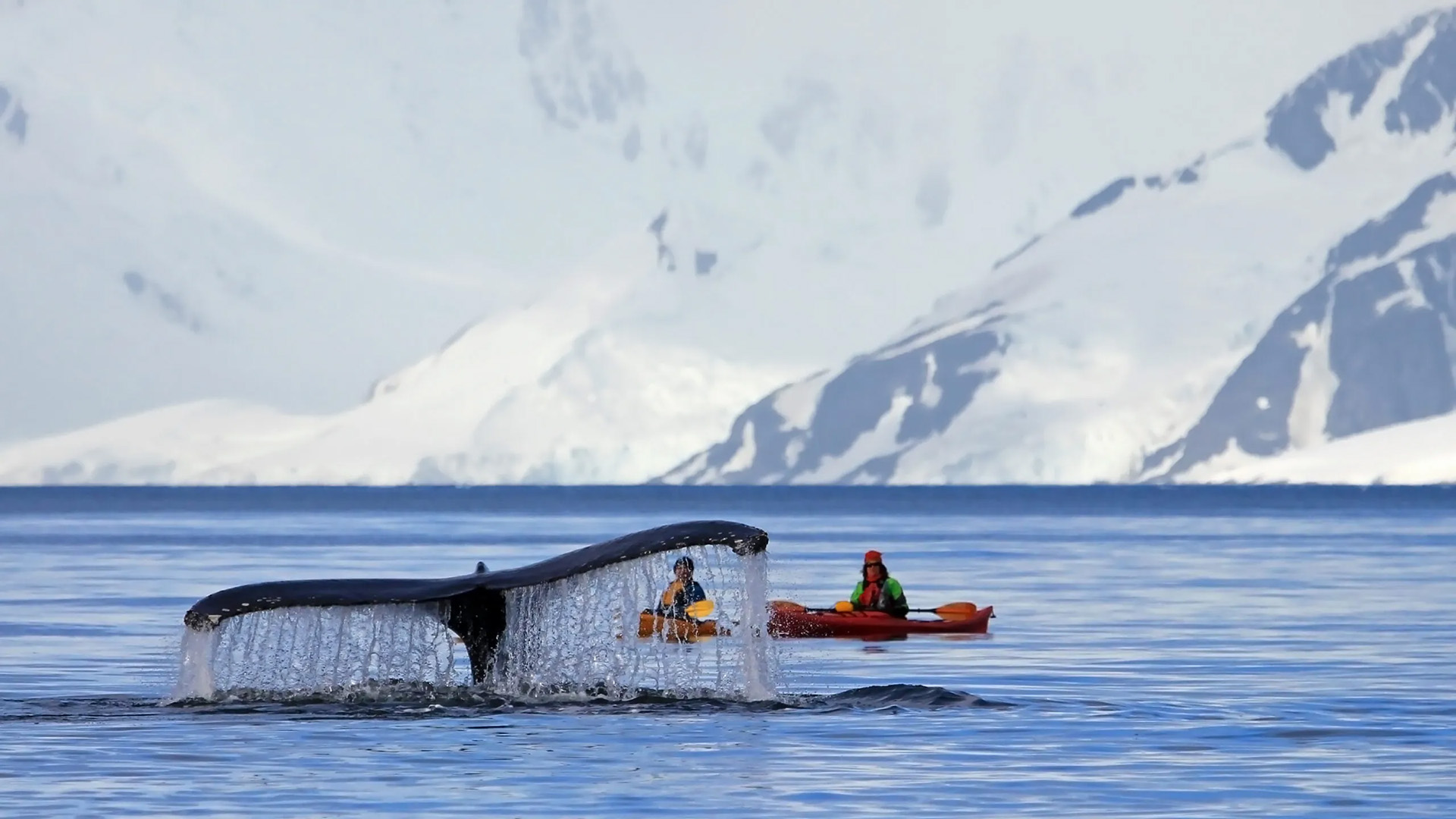
Whale-watching by kayak in Antarctica’s icy waters / © Secret Atlas Media
Origins and First Impressions
Q: Do you remember the first time the polar regions captured your imagination? What was it that grabbed you?
Yes—very clearly. My first exposure to the polar regions was in Antarctica, and it was personal rather than professional. What struck me immediately was the scale of the place, but even more than that, the absence of noise. It felt stripped back—no visual clutter, no unnecessary movement. You suddenly become very aware of yourself in the landscape, and of how small you are within it. Very small.
Q: Was there a single moment during that first polar voyage when you thought, “My life is never going to be the same after this”?
Antarctic Peninsula. February 2013. It wasn’t a single dramatic moment. It was a gradual realization that this was a place that demanded a different pace and a different mindset. The polar regions don’t reward rushing or control. That understanding stayed with me long after the voyage ended.
Q: For someone who has never been to the polar regions, how would you describe the first impression of stepping into that vast, seemingly empty landscape?
It feels empty at first, but very quickly you realize it’s anything but. The space sharpens your senses. You notice light, texture, distance, and movement in a way that busy environments don’t allow. It’s not overwhelming—it’s clarifying.

Gentoo penguins glide gracefully through the icy waters of Neko Harbour /
Credit: Jean-Paul de la Harpe – Secret Atlas
Early Influences and Path to Exploration
Q: When you were growing up, was there a person, book, or experience that you now realize quietly prepared you for the work you do with Secret Atlas?
Looking back, I was always drawn to ALL stories of exploration, sailing, and self-reliance—narratives where progress came from patience rather than conquest. At the time, they felt like escapism. In hindsight, they quietly shaped how I think about travel, leadership, and responsibility in remote places. HW Tilman and his books were clearly a driver.

Scoresbysund in Eastern Greenland bathed in the warm glow of late afternoon sunlight /
Credit: Steve Allen
Founding Secret Atlas
Q: What was the turning point where you went from “I love this place” to “I’m going to co-found a company around it”?
It was a specific expedition: Scoresbysund, East Greenland, summer 2018. It made it very clear there was another way to explore these regions. Not bigger, not louder, not more efficient, but more intentional. That journey crystallized the idea that scale, restraint, and depth of experience mattered more than volume. That conviction became the foundation of Secret Atlas.
Q: Has there ever been a moment when you doubted the path you’d chosen with Secret Atlas, and what brought you back to it?
No—never. From the beginning, this has felt like a rare opportunity to connect with discerning, like-minded explorers and to follow our north star very clearly. The clarity of purpose has always been there.
Q: How would you describe your own travel philosophy, and how does it show up in Secret Atlas?
Deeper engagement and access with restraint. We travel slowly, deliberately, and with respect for limits—both environmental and human.

Polar bear cubs joyfully playing together on the ice / Credit: Alexey Seafarer
Experiencing the Arctic and Antarctic
Q: Would you recommend Svalbard as a first Arctic destination? If so, what makes it such a powerful introduction for newcomers?
Absolutely. Svalbard offers immediate immersion: glaciers meeting the sea, wildlife at close range, and a rawness that feels uncompromised. It’s accessible, but it doesn’t dilute the Arctic experience. It sets expectations honestly.
Q: How would you describe the silence—or the soundscape—of Svalbard to someone who’s only ever known the constant background noise of cities?
It’s not silence in the absolute sense. It’s the absence of artificial noise. You hear wind, ice shifting, the call of birds, the sound of water against the hull. The calving glaciers. The quiet feels deliberate, not empty.
Q: Is there a particular wildlife encounter that still gives you goosebumps when you talk about it?
A polar bear swimming across Scoresby Sund. It wasn’t staged or dramatic—just purposeful, calm movement across open water. It was a reminder of how capable wildlife is in environments we often label as “extreme.”

A magnificent leopard seal near the Zodiac boat during our Antarctic expedition /
Credit: Csilla Kiss – Secret-Atlas
Expedition Micro Cruises Explained
Q: For readers who are new to the idea, how do you define an “Expedition Micro Cruise” in simple terms?
It’s a voyage designed around access, flexibility, and depth, rather than schedules or volume. Small groups, small ships, and the freedom to respond to conditions in real time.
Q: Why did you decide to limit guest numbers so drastically when larger ships might be more profitable?
Because profitability was never the primary metric. Smaller groups allow for quieter landings, deeper engagement, and genuine presence in the landscape. Beyond a certain size, those qualities disappear. The constant search for maximizing the guest experience is our fuel.
Q: What are some experiences your guests have on a 12-guest voyage that simply aren’t possible on a ship carrying hundreds of people?
Extended time ashore. Unhurried exploration. Spontaneous decisions. Shared silence. Conversations with like-minded, discerning explorers that continue over days rather than minutes. And a sense that you are part of the expedition, not an observer of it.
Q: Does ship size matter on an Antarctic cruise, and if so, how does it change the experience day-to-day?
Yes—immensely. Ship size affects everything: landing flexibility, time ashore, how wildlife encounters unfold, and how connected guests feel to both the place and each other. Smaller vessels allow Antarctica to reveal itself gradually. Expediiton Micro Cruises can be operated on any ship carrying less than 50 guests.
Q: From your point of view, why is travelling by small expedition vessel the best way to experience these regions?
Because these places operate on their own terms. Small vessels allow us to listen—to weather, ice, light, and wildlife—and respond accordingly. That responsiveness is the essence of real exploration.
Q: How does a dedicated photography cruise differ from a “regular” Secret Atlas expedition?
The pace slows further. Landings are longer. Light dictates decisions. There’s more waiting, more observation, and more space for creative focus. Everything is designed to support patience to allow our guest to get that shot.

Antarctic shag, the sole cormorant of Antarctica / © Secret Atlas Media
Nature in Control
Q: What role does Mother Nature play in your expeditions?
She defines everything. The itinerary is a framework, not a promise. Conditions shape each day, and guests quickly learn that uncertainty isn’t a problem to be solved—it’s part of the experience.

Guests enjoy panoramic views from the open decks aboard the Polar Athena /
© Secret Atlas Media
Impact, Responsibility, and Change
Q: After your first voyages, what did you realize about your own lifestyle and its impact on fragile polar environments?
That speed matters. Slowing down—how we travel, how often we move, how much we consume—has a direct relationship with impact. The polar regions make that relationship impossible to ignore.
Q: In your experience, what happens to people’s attitudes when they see the Arctic or Antarctica with their own eyes?
There’s a shift toward humility. People become more patient, more aware, and more comfortable with silence. The noise of daily life feels less urgent afterward.
Q: How do you hope guests will live differently after they return home?
With a clearer understanding of how fragile these ecosystems are—and with a heightened sense of responsibility. Awareness is often the first and most important step.

Guests take in the fresh polar air and stunning landscapes from the open viewing deck of
the Polar Athena / © Secret Atlas Media
The Secret Atlas Guest
Q: Who do you picture when you think of the “ideal” Secret Atlas guest, and how do you personally relate to that person?
Discerning, curious, well-travelled, and comfortable with uncertainty. Someone who values knowledge over spectacle. In many ways, they reflect how I approach travel myself.
Q: If someone is dreaming of a polar trip but hesitating, what would you say to help them decide?
We don’t need to reassure anyone—it’s very clear this is an adventure. There are no fixed schedules and no guaranteed outcomes. Every expedition is different, because the conditions given by Mother Nature are always different. That’s exactly the point.

Hiking across the frozen sea in the breathtaking expanse of the Polar Circle /
Credit: Mariano Curiel – Secret Atlas
A Quieter Way to Explore the Poles
Responsible polar travel begins with humility: accepting uncertainty, slowing down, and allowing nature to set the pace. As D’Agostino’s reflections make clear, the most meaningful expeditions are not defined by distance covered or boxes ticked, but by attentiveness, depth, and the perspectives carried home afterward. For those drawn to this quieter approach, Secret Atlas offers a way to experience the Arctic and Antarctic through small-scale, carefully considered journeys that protect what makes these places distinct.